From the beginning, I knew that adapting Huxley's Reservation would be one of the biggest challenges. His version, full of stereotypical imagery of Native Americans from the 1930s, felt both dated and exoticizing. My goal was to create a new Reservation that felt like a real, believable place for a modern teen audience — a society shaped by isolation and hardship, not by cliché. To do this, I needed a strong visual and ecological foundation.
To build a believable world, I first needed to understand its history. The module provides a reason for the Reservation’s existence that is part historical, part geographic, and part economic. As Bernard explains to the viewer:
“When the World State was formed, the people who lived out here didn't want to join. And this land..." he gestures towards the harsh landscape – "...it's difficult. Too hot, too dry, old pollution from before. The Controllers decided it would cost too much money and effort to fix it, to make it modern like our cities.”
The module's "Caliban Reservation" is both autonomous and precarious, its people suspended between self-imposed isolation and pariahhood. The Reservation is cut off from the easy comforts of "civilization" while still scarred by historical harms - a condition inspired by the real-world situations of many marginalized communities. This backstory informed the design of the "border crossing" arrival scene, which introduces the viewer to the Reservation's profound separation from the World State and the complex realities of cross-border movement.
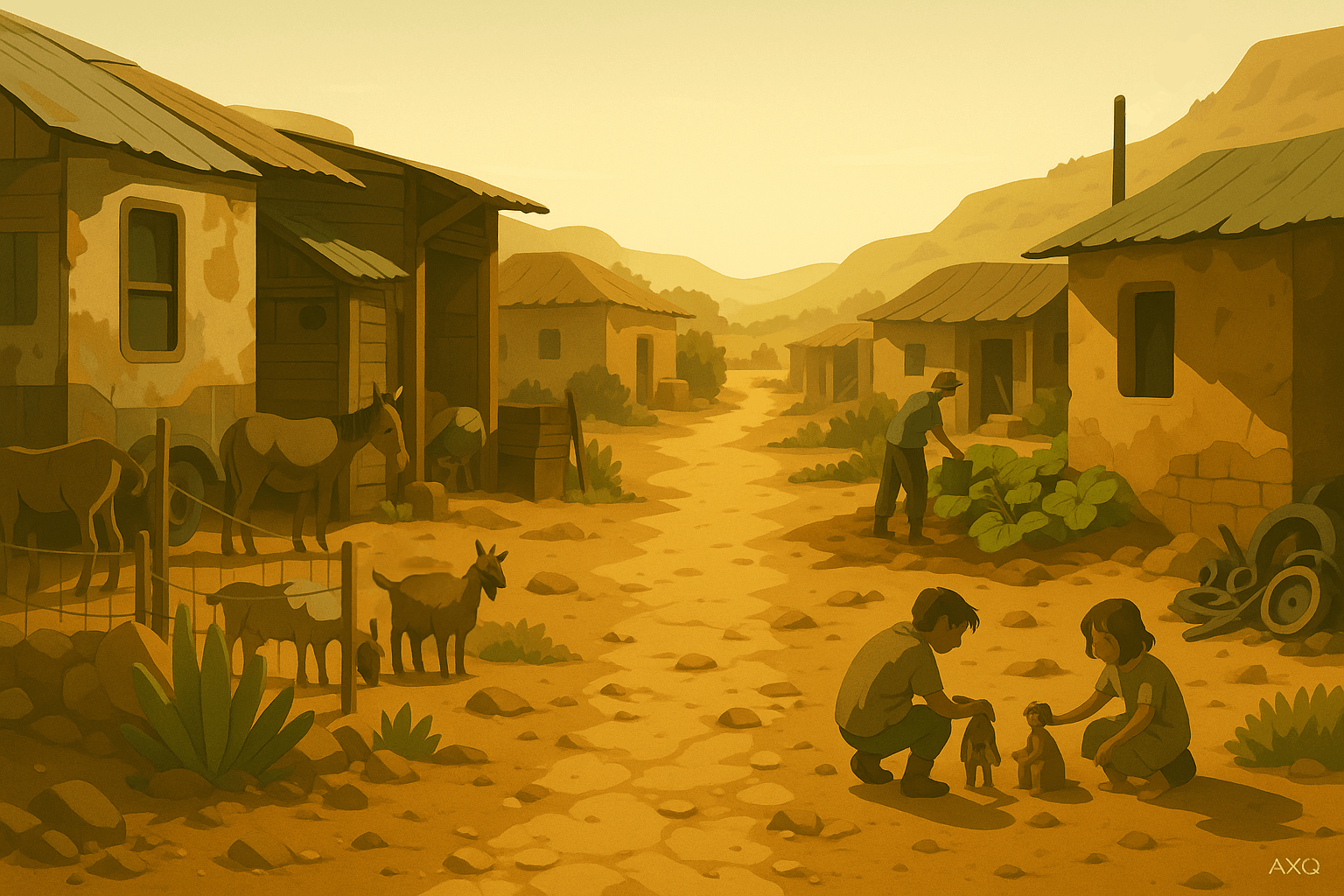
My initial inspiration for the settlement's look came from Slab City, a real-life squatter community in the California desert. Its haphazard, improvised dwellings — made from a mix of scavenged objects and natural materials — captured the resourceful, off-grid feeling I wanted. The first images I generated using this idea had a slight post-apocalyptic feel that I liked.
But as I looked at these images, it occurred to me what kinds of questions an observant student might ask: How do they get enough water to survive? Where do they get their food?
I realized that for the Reservation to be truly believable, its aesthetic had to be supported by a plausible ecology. The hyper-arid desert of Slab City couldn't sustain a permanent, isolated community for over 400 years.
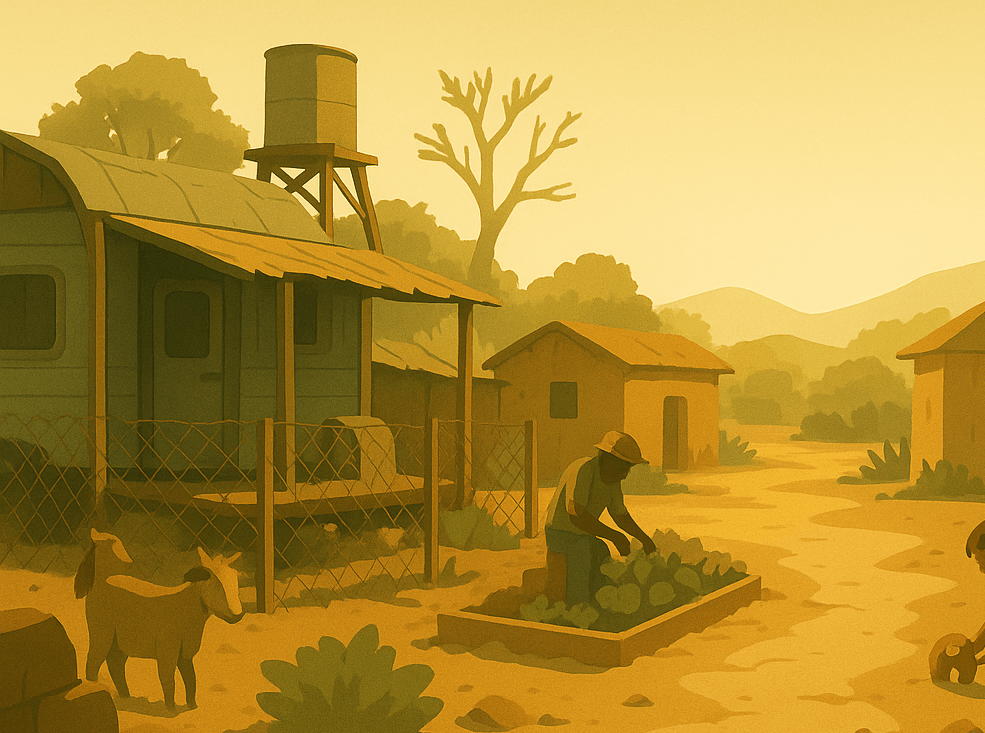
Ultimately, I decided to transpose the "Slab City" aesthetic to a more viable, though still harsh, bioregion: the semi-arid high desert and broken badlands of New Mexico, where Huxley's original Reservation is set. That environment, while difficult, could plausibly support a small population surviving through harvesting rainwater, small-scale farming, and foraging. This geographical shift grounded the story in a more realistic foundation.
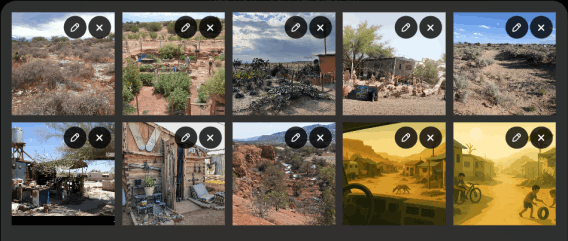
Examples of reference images used for Sora
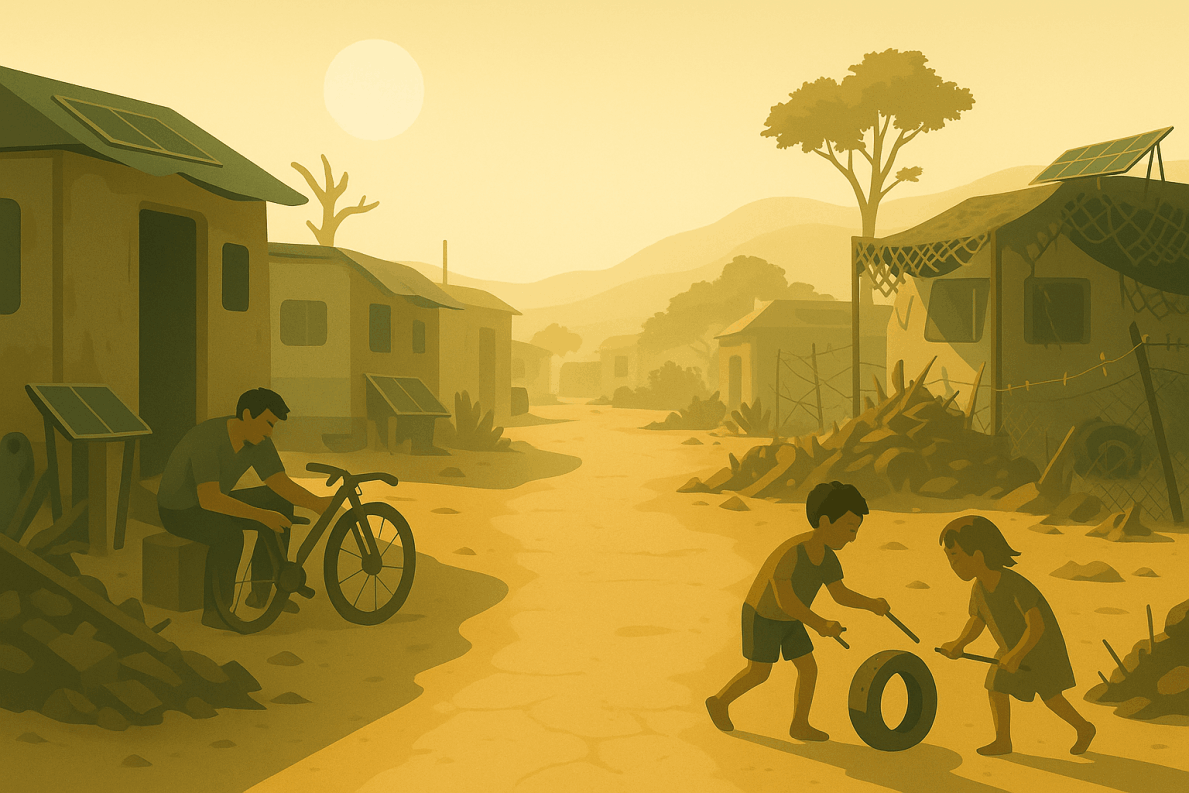
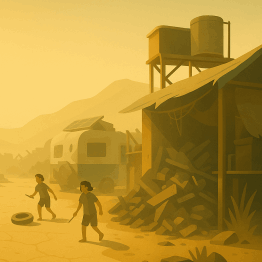
With the new environmental base, the details of the Reservation's world began to come into focus. It became a world of necessary adaptation, where old trailer homes were reinforced with local adobe mud, where scavenged scrap metal was used to build windmills for pumping water, and where daily life revolved around careful management of scarce resources.
This detailed worldbuilding allowed for a more cohesive story and more believable characters. With my adapted Reservation in mind, I re-imagined specific scenes from the novel and updated the portrayal of the Reservation's two central characters.
Here are two examples of how I adapted specific scenes from Huxley's novel to fit the module's updated setting and tone.
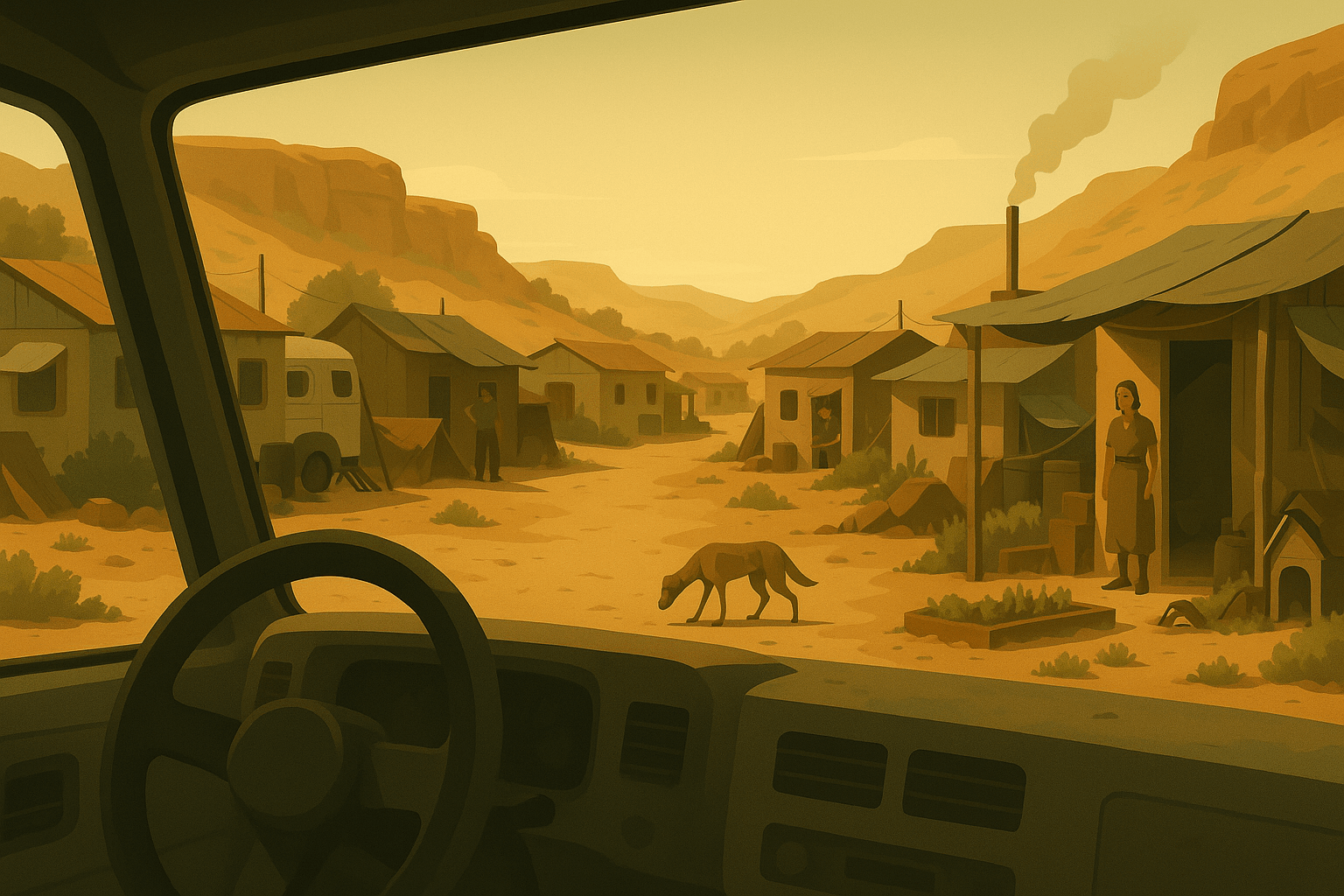
First was the "arrival" scene. In the book, characters fly directly to the pueblo. I created the module’s "border crossing" scene to better emphasize the Reservation's isolation and to echo the complexities of borders in our own time. The bumpy, hour-long truck ride through the badlands serves as an important transition, making the viewer feel the distance and difference between the Reservation and the World State.
|
[...] "Special permission," Bernard tells the guard, handing over the papers. "Visitor access approved by the Western Europe Controller's office."
The guard takes the papers, gives them a brief, routine check. "Alright. Settlement's about an hour's drive that way." He points vaguely across the shimmering, flat land beyond the gate. "Popé'll take you." He nods towards the truck parked nearby.
|
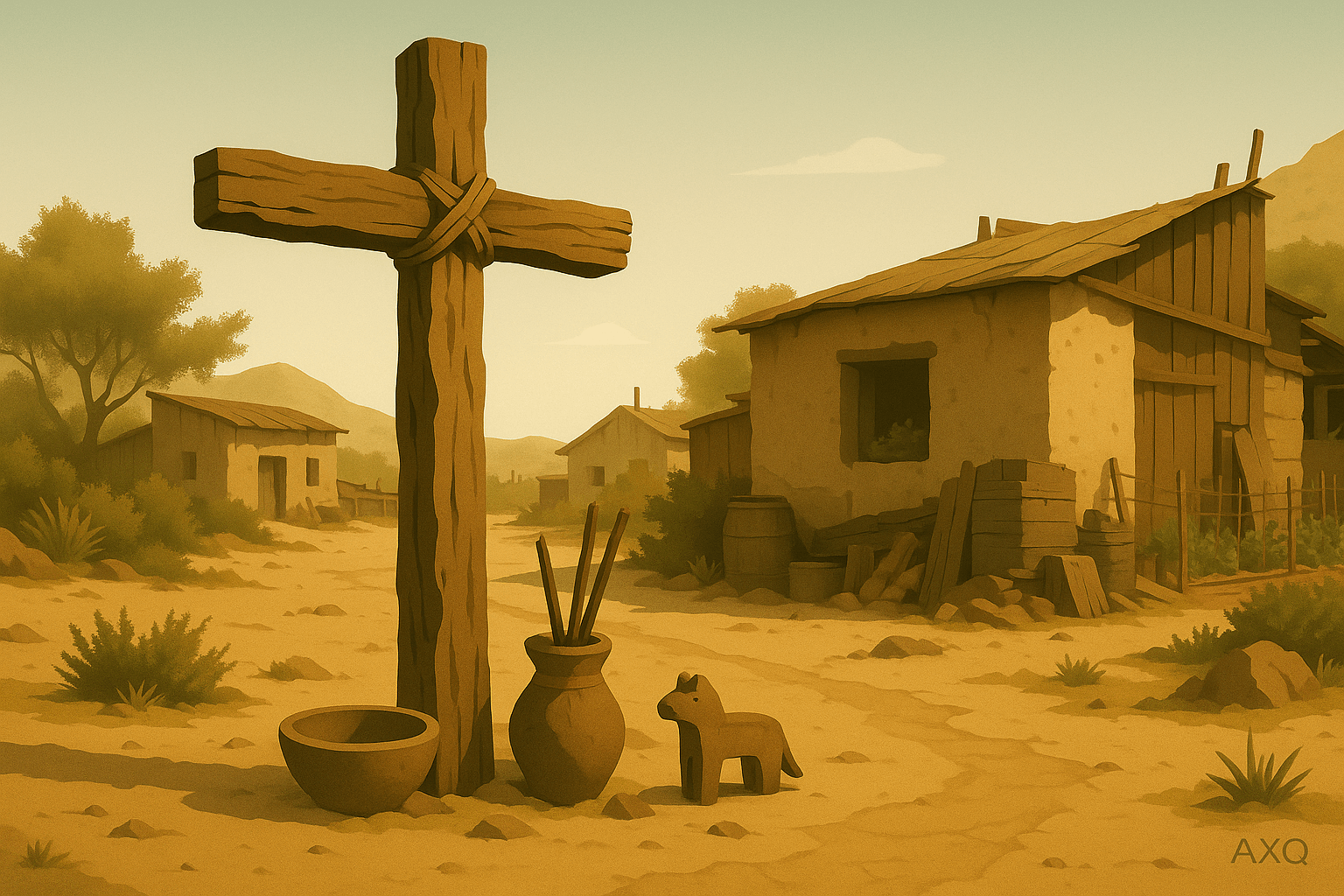
Second, I adapted Huxley’s depiction of a religious ceremony. The original scene, featuring masked dancers, snakes, and a ritual whipping, felt too exotic and sensational. I replaced it with a quieter, more personal encounter with a handmade religious marker — a simple wooden cross set with carved animal figures. This preserved the syncretic, spiritual aspect of the Reservation's culture in a way that felt more grounded in the community's makeshift, resourceful reality.
I wanted to portray the Reservation’s main characters, John and Linda, with more dignity and relatability than the original novel. Huxley's descriptions are often caricatures: Linda, for example, is described as a fat, slobbering "creature" with missing teeth, while John appears in stereotypical "Indian dress."
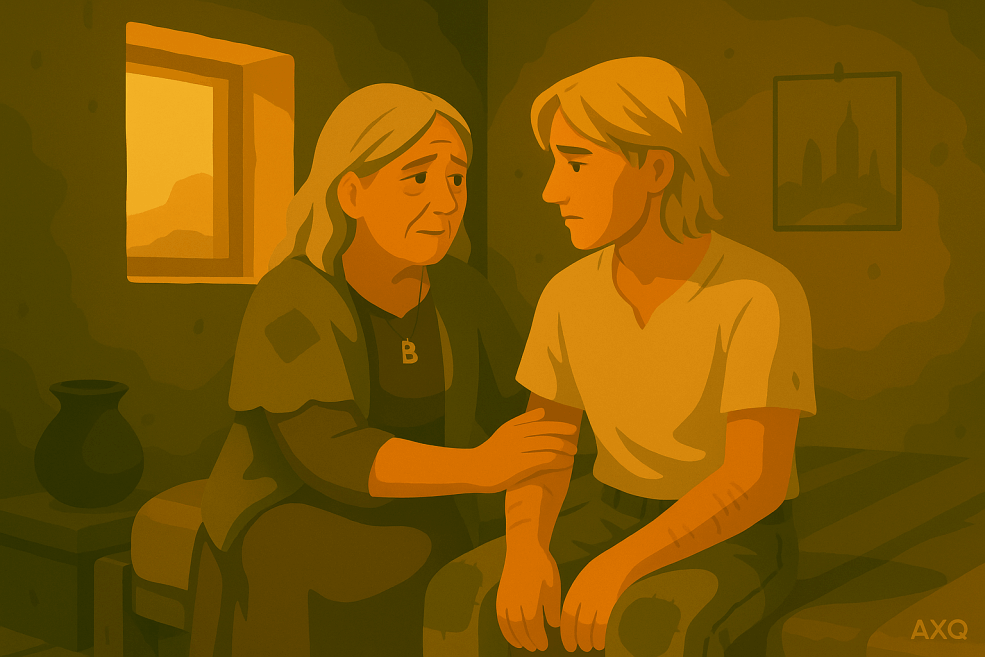
| Huxley's description of Linda: "A very stout blonde squaw stepped across the threshold and stood looking at the strangers, staring incredulously, her mouth open. [...] the red veins on her nose, the bloodshot eyes. And that neck - that neck; and the blanket she wore over her head - ragged and filthy."
|
In contrast, I tried to portray them as complex individuals shaped by their difficult circumstances. My Linda is aged by hardship, but her eyes are still "sharp," and her home is simple but clean, not squalid. The story she tells focuses on the impossible choice she faced between returning to her comfortable home and abandoning her son, giving her a tragic depth.
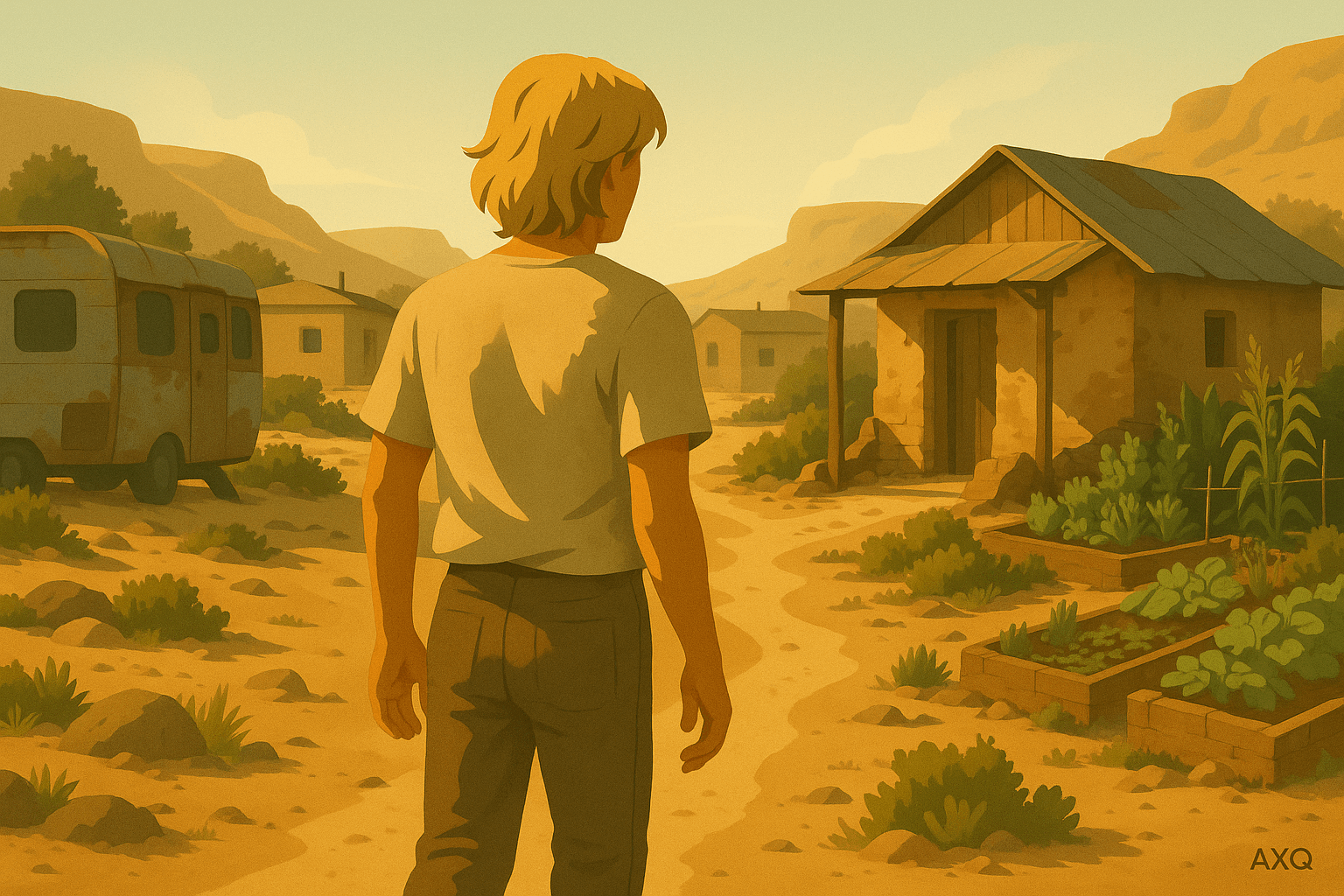
Similarly, my John wears a simple T-shirt and worn pants, and his dialogue focuses on his internal struggle to understand concepts like "honor" from his old books, making him a more universal figure of a thoughtful, isolated young person trying to find his place in the world.
| John: "I was reading last night... about ‘honor’. The man in this story, Othello, he dies for his honor. And for love. [...] I was trying to understand why a person would do that. Here on the Reservation, people fight when they are angry or jealous. But... to die for an idea? Why is an idea more important than life itself?"
|
My re-imagined Reservation, based on salvaged, adapted materials from the "Before" era, gave John a role as a "fixer" of the community's precious, jerry-rigged technology.
| John: "It's the only life I know." He looks around at the old homes and dry earth. "It can be hard. Sometimes there isn't enough water, or the wild plants we eat don't grow well. People get angry, they argue sometimes. I fix things – broken tools, water pumps – to earn food or useful stuff."
|
The goal was to encourage empathy, not to present the characters as exotic "savages."
Ultimately, by starting with a visual idea and then digging deeper into the ecological and social questions behind it, I sought to create a Reservation that felt less like a stereotypical backdrop and more like a real place, allowing for a more sensitive and empathetic exploration of its characters and way of life.

HTML Website Maker