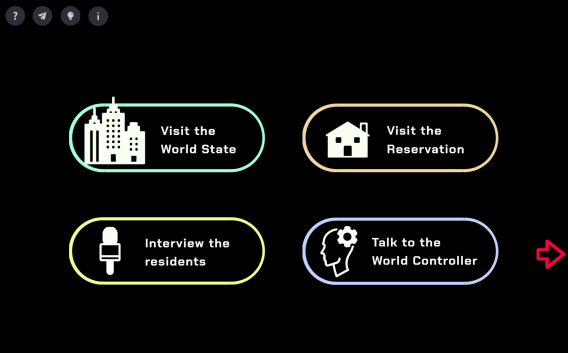
The location of the link to the secret "chapter menu"
This page contains some practical advice, answers to potential student questions, and resources for extending the learning beyond the module.
The "chapter menu":
On the module's main menu, there is an invisible link on the right side of the screen. (See image below.) Clicking this link will take you to a "chapter menu" that allows you to skip directly to key plot points in each section. This is designed to help you quickly review a section or demonstrate a specific scene in class without having to click through the entire narrative again.
Teacher's note:
It's recommended that you do not show this link to students on their first playthrough, as it can spoil the sense of discovery.
Exploring the endings:
The choices in the module lead to different outcomes. I highly recommend that you use the chapter menu to experience both endings of the Reservation section and all four endings of the Controller section to fully understand the different paths your students might take.
The location of the link to the secret "chapter menu"
Here are a few questions that might come up in class:
"Why is there no C caste?":
This is a great opportunity to discuss the module as an adaptation. You can explain that the original book's castes were named after Greek letters (Alpha, Beta, Gamma, Delta, Epsilon). For clarity, the module simplified the system to four main groups (A, B, D, E) and used English letters. You could even ask students: "Why do you think the designer chose to leave out the middle group, the Gammas?"
"Why does it use American spelling like Center if it's set in London?":
The "in-world" explanation could be that the global World State has adopted a standardized form of English based on American spelling. The real-world reason is simply that I, the module designer, am used to American spelling.
Using excerpts from the original book:
To connect the module back to Huxley's original text, you might consider using short, adapted excerpts for comparison and analysis. Some particularly relevant sections include:
― The Director's initial tour of the Hatchery (Chapter 1)
― The description of the Savage Reservation ceremony (Chapter 7)
― John's memories of discovering Shakespeare (Chapter 8)
― The scene at the Hospital for the Dying (Chapter 14)
― The final philosophical debate between John and the World Controller (Chapters 16 & 17) (for advanced students)
A note on copyright:
This website does not host excerpts from the novel, as it is still under copyright. Adapting short excerpts for direct, non-commercial use within your own classroom for discussion and analysis may fall under "Fair Use" principles. However, copyright law is complex — it's best to consult your own school or district's guidelines.
Other adaptations:
Discussing different adaptations could be a great media literacy lesson. In addition to the 2020 TV series (a clip of Bernard and Lenina flying to the Reservation can be found here), you could explore the 1998 TV movie starring Leonard Nimoy, or even BBC radio dramas of the novel to discuss how the story changes without visuals.
Finally, I wanted to share a brief note on the philosophy behind the module's design. The goal of the module isn't to provide students with definite answers about what makes a "good" society, but to give them the tools and the space to ask better questions. By allowing students to grapple with the story's ambiguity, confront conflicting viewpoints, and make their own difficult choices, I believe the learning experience becomes more personal, memorable, and meaningful.
To see the resources your students will use, visit the Learner section of the website.
To learn more about the creation of this project, visit the How I made this page.

Website Software