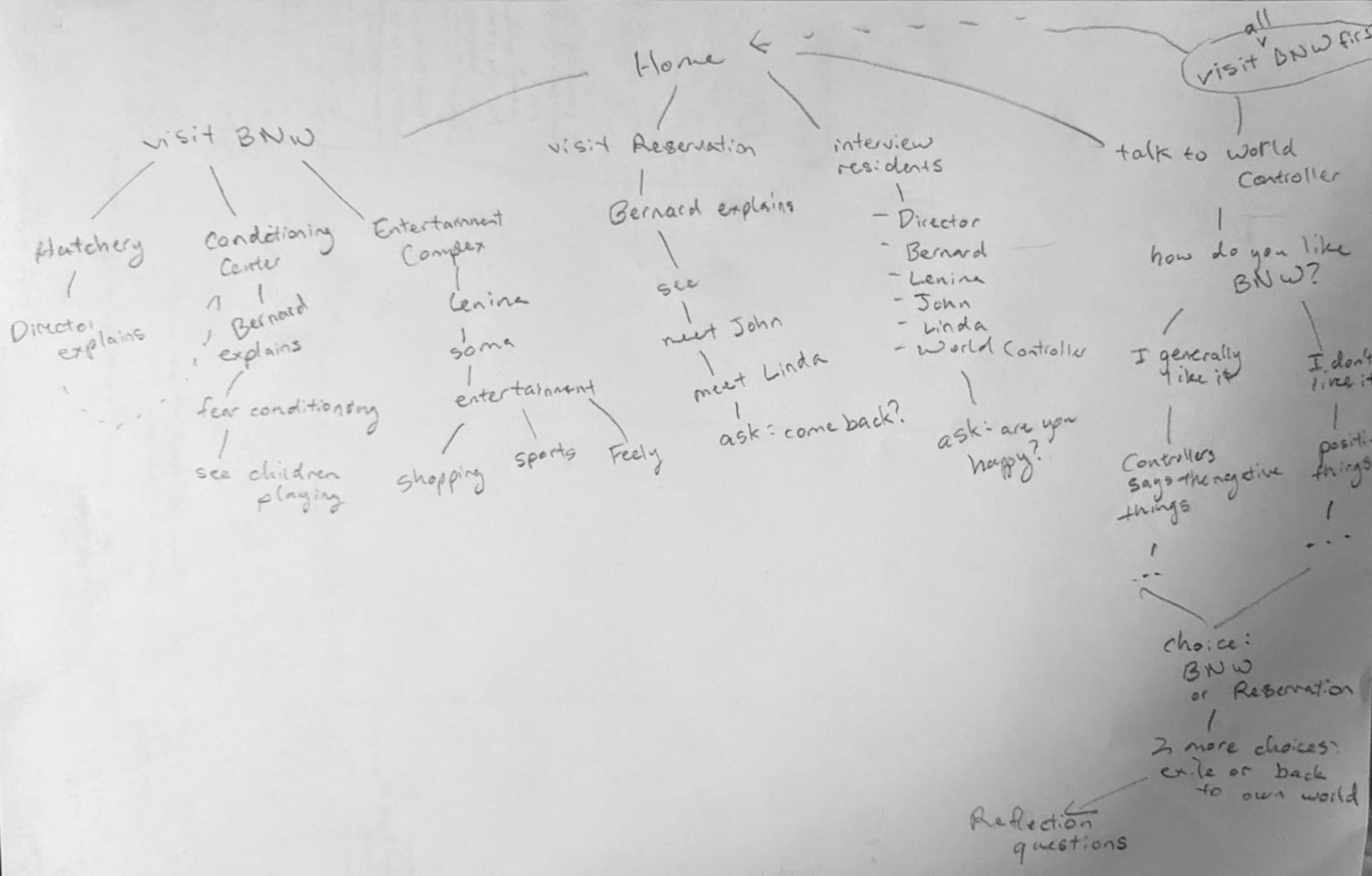
Flowchart showing the initial structure of the module
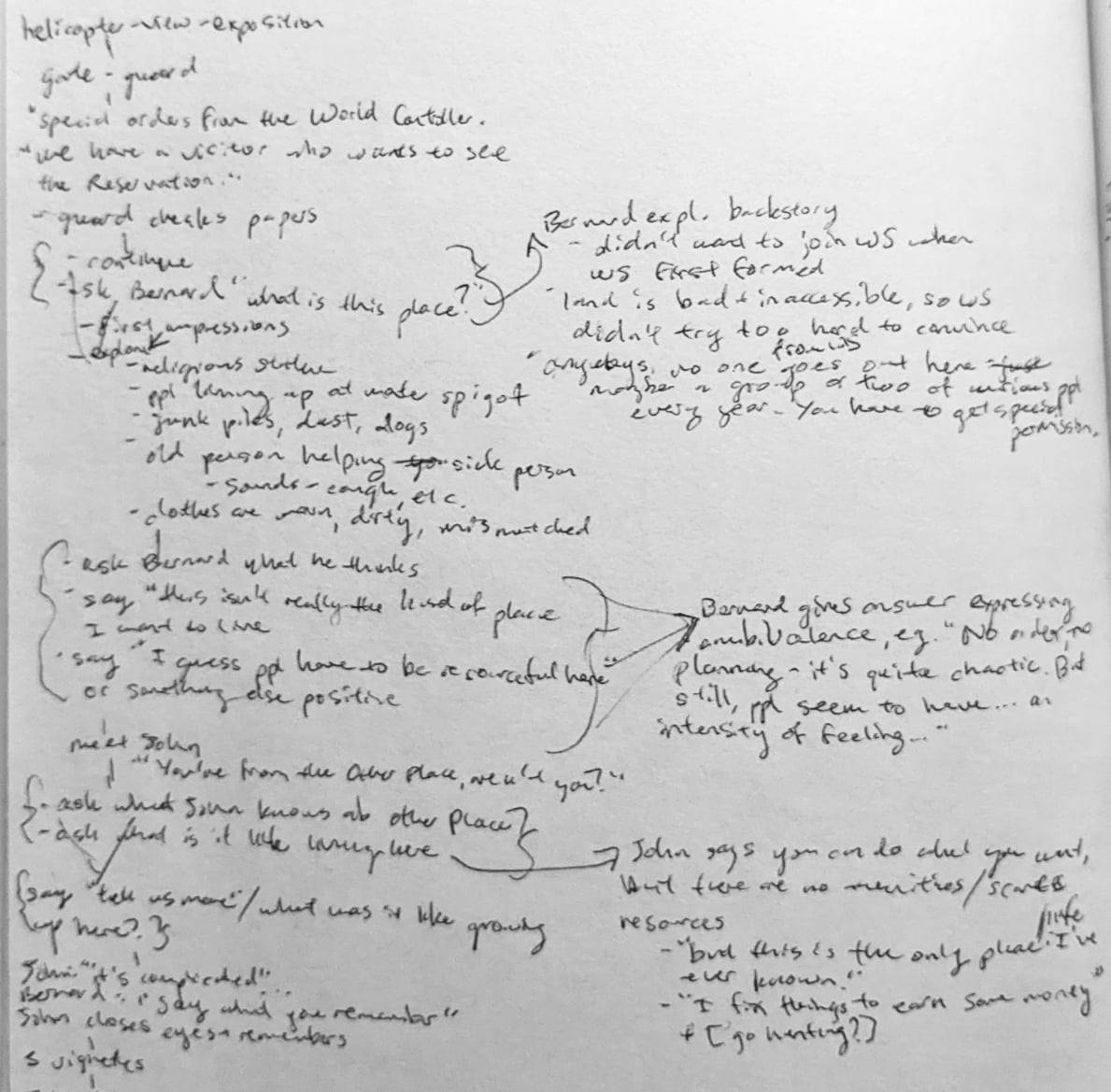
Planning the Reservation section
The goal of this project was to adapt Aldous Huxley's classic novel, Brave New World, into an interactive learning resource for 14-16 year-old English language learners (CEFR B1+, lower-intermediate level). The module was designed to strengthen language skills while prompting critical thinking about society, technology, and citizenship — key cross-curricular themes in the Austrian secondary schools where I worked. The challenge was to make the novel's complex philosophical questions accessible and engaging without oversimplifying them.
The result is a choice-based interactive story that immerses the learner in the world of the novel. Built in Genially with AI-generated illustrations, the module allows learners to explore two contrasting societies: the stable, engineered World State and the rugged, unpredictable Reservation. Key features include nuanced character interviews, an evidence-based debate with the World Controller, and multiple, ambiguous endings that encourage personal reflection on what makes a life worth living.
Learning experience design:
Learner analysis, narrative-based learning, storyboarding, scriptwriting, user agency & interactive design
Creative & technical:
AI visuals (Sora 1), AI collaboration (various LLMs), interactive module development (Genially), website & resource creation (Mobirise, Github, Cloudflare Pages)
In my work as a teaching assistant, I’ve seen students of all ages respond positively and engage deeply with role-playing activities and decision-making scenarios. That experience informed the structure of this module: it would be story-based, immersing the learner in the world of Brave New World and letting them discover places, meet characters, and make their own choices. The branching narrative would give the learner agency, increasing motivation by letting them control key moments of the story.
I didn’t want to provide any facile answers about society and politics - instead, I wanted the learner to feel like an explorer, thinking through their own opinions by grappling with multiple, conflicting viewpoints. This culminates in the debate with the World Controller, which asks the learner to synthesize their experiences from across the module. At each step, I tried to think from the perspective of a 14-16 year old English language learner, using visual storytelling and accessible text to make the narrative clear, relevant, and immersive.
My main concern in structuring the module was to convey the essence of Brave New World while giving the learner real opportunities to control the direction of the story. I settled on a “visitor” premise, allowing the learner to discover Brave New World’s customs and contradictions alongside “guides” or accompanying characters.
The module is built in four parts. Three parts follow a central storyline: the rational World State, the untamed Reservation, and a culminating debate with the World Controller. The fourth, independent section, "Interview the Residents," adds nuance and emotional depth to the main characters.
I started by mapping out the flow of events with sketchbook notes and flowcharts:
Flowchart showing the initial structure of the module
Planning the Reservation section
Since I planned to develop the script using an LLM, I then created a detailed outline for the module. I gave this to Gemini 2.5 Pro to create a first draft of the narrative.
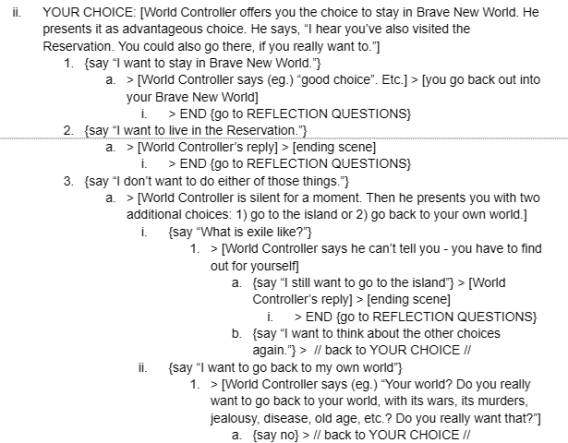
Part of the outline used to create the initial script
The scriptwriting process involved making choices about how to adapt the novel's original content for a modern teen audience.
Adapting a classic novel into an interactive module for teens required making some structural and thematic changes. My goal was to preserve the book's core philosophical questions while making the narrative focused and relatable.
Early on, I decided to exclude a number of Huxley's secondary characters to keep the story centered on the main cast and their conflicting worldviews. I also simplified the original five-tiered caste system to four groups (Alpha, Beta, Delta, Epsilon). Leaving out the middle Gamma caste helped to make the social structure more immediately understandable through cues like clothing color and the English-letter lapel pins.
Another significant adaptation involved Huxley’s treatment of relationships. The novel's focus on sex and promiscuity felt like a complex and potentially distracting topic for the target age group. Instead, I chose to focus on the World State’s elimination of families and deep, exclusive friendships. This let the module explore the same fundamental question — whether forgoing deep personal connection is necessary for social stability — in a way that felt more accessible and universally relatable for 14-16 year-olds.
With the initial draft of the script in hand, I was able to run through the journey the learner would follow more closely. The text went through numerous revisions, with some sections expanded significantly through the addition of worldbuilding elements, more nuanced characterization, and more opportunities for the learner to exercise their agency.
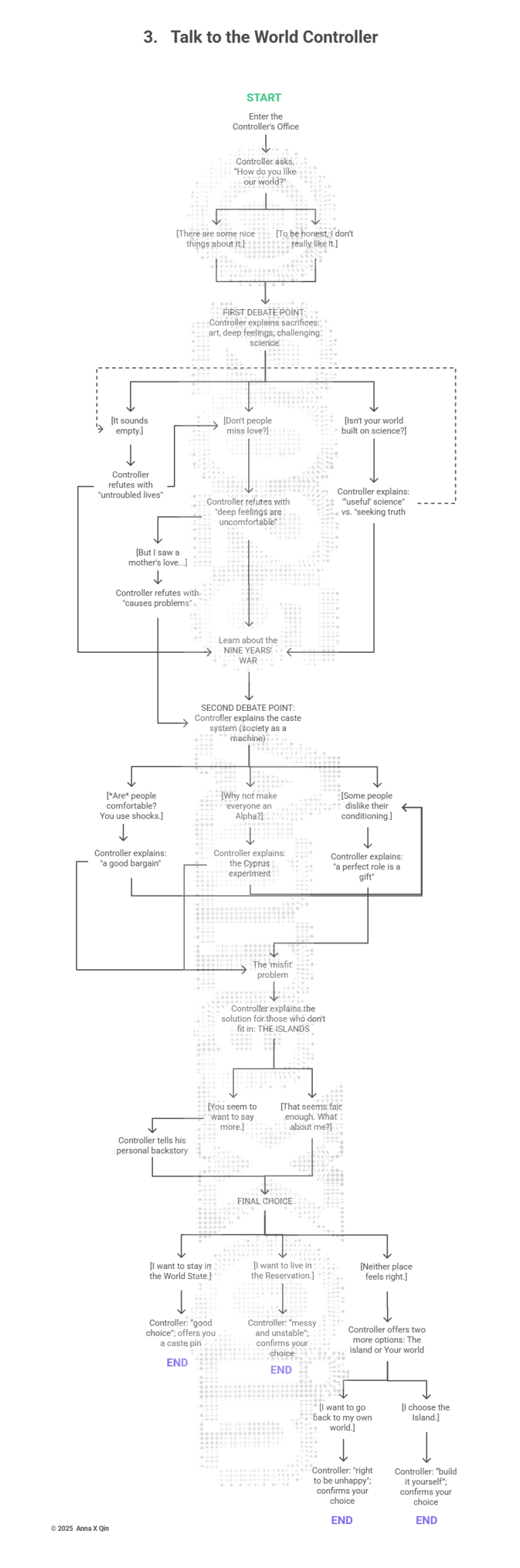
For example, here is the final flowchart for the culminating debate with the World Controller:
For the module’s illustrations, I wanted an art style that would appeal to teens — one that was both atmospheric and emotionally resonant. Inspired by graphic posters and video game art, I developed a vector-like illustration style to create an immersive world with stylized yet emotionally legible characters.
While both the World State and the Reservation share the same general art style, the color palette marks them as distinctly separate places. The World State’s predominately cool colors and sleek contours evoke an ethereal, futuristic world of affluence and emotional regulation, while the Reservation’s dusty oranges and earth tones suggest a place marked by scarcity and adaptation to the local environment.
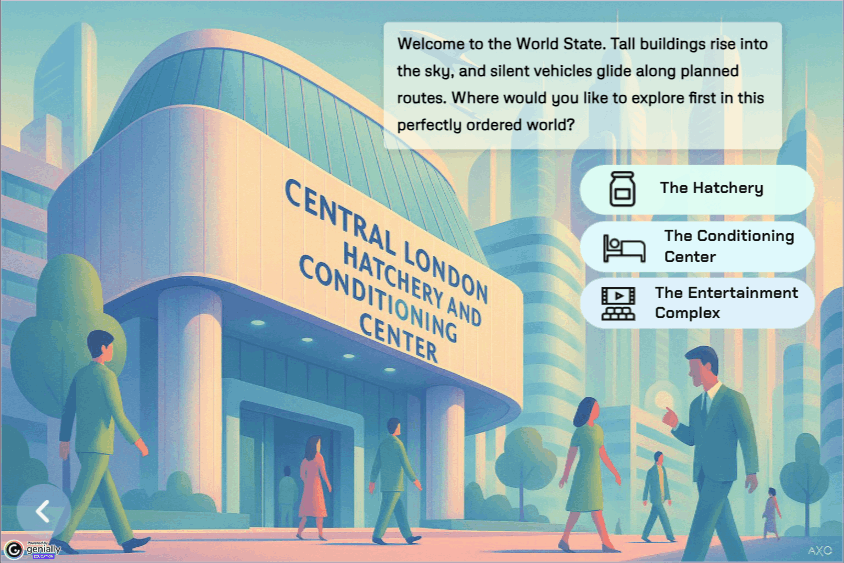
Example slide showing the World State's color palette
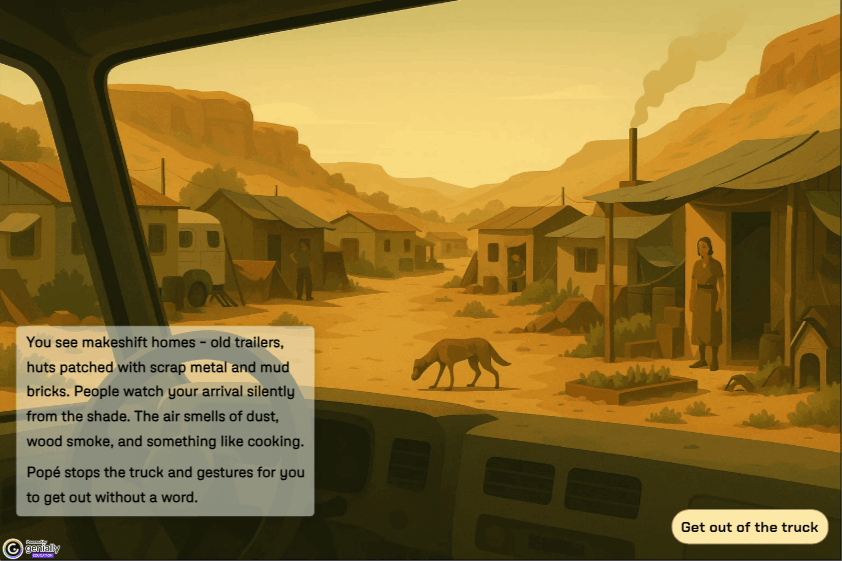
The color palette for the Reservation
A major concern was to integrate the World State’s caste system visually. Inspired by the 2020 TV adaptation of Brave New World, I gave all World State characters lapel pins showing their caste. Other details, like holographic displays and artificial trees, help create a world that feels futuristic but also uncomfortably similar to our own.
Creating the module's illustrations was an iterative process. First, while writing the script with Gemini, I had it insert short, conceptual ideas for illustrations. Once the script was finalized, I defined the look for each of the six main characters and the aesthetic and worldbuilding details for each of the locations (the Hatchery, the Entertainment Complex, etc.).
Then, I returned to Gemini to flesh out the short ideas into full prompts for the image generator Sora. I found that I usually needed to edit the AI-generated prompts, provide multiple reference images, and "remix" or re-use previously generated images to get the best results.
Using reference images was especially helpful for complex scenes with no real-world analogs. For example, depicting the complicated machinery of the Embryo Storehouse in the Hatchery convincingly was a challenge. I was inspired by the cleanrooms in semiconductor fabs — a fitting visual reference, I thought, for the Storehouse’s precisely-controlled, high-tech, mass-production processes. Giving Sora reference images of cleanroom equipment together with the text prompt produced a more believable and striking final illustration.
The final module carries the imprint of changes across the design process, with the end result prioritizing a coherent narrative and philosophical depth over complex game mechanics. The module was built in Genially, which offered more control over user navigation than my initial idea of Google Slides.
The website was designed in Mobirise, with supplementary resources created with AI assistance. Feedback is gathered via Google Forms. Two early testers gave me valuable feedback about the module, helping me improve element visibility, clarify navigation, and improve Bernard’s characterization.
The initial plan was to create the module in Google Slides, a tool I was already familiar with. However, after some research, I realized I needed more robust control over user navigation to prevent learners from accidentally breaking the story's flow. I decided to build the module in Genially instead, as its interactivity features and embedding options were much better suited for a branching narrative.
Time was also a constraint. I had initially considered adding short video clips and background audio to the module, but decided against it to keep the project manageable. I prioritized creating a coherent narrative, focusing on making the text clear and the illustrations as impactful as possible.
Before finalizing the project, I asked two testers to go through the module. Based on their feedback, I clarified the navigation to the Entertainment Complex, adjusted several illustrations, improved the visibility of a few user interface elements, and made Bernard’s conflicted feelings about the World State more evident from his first appearance.
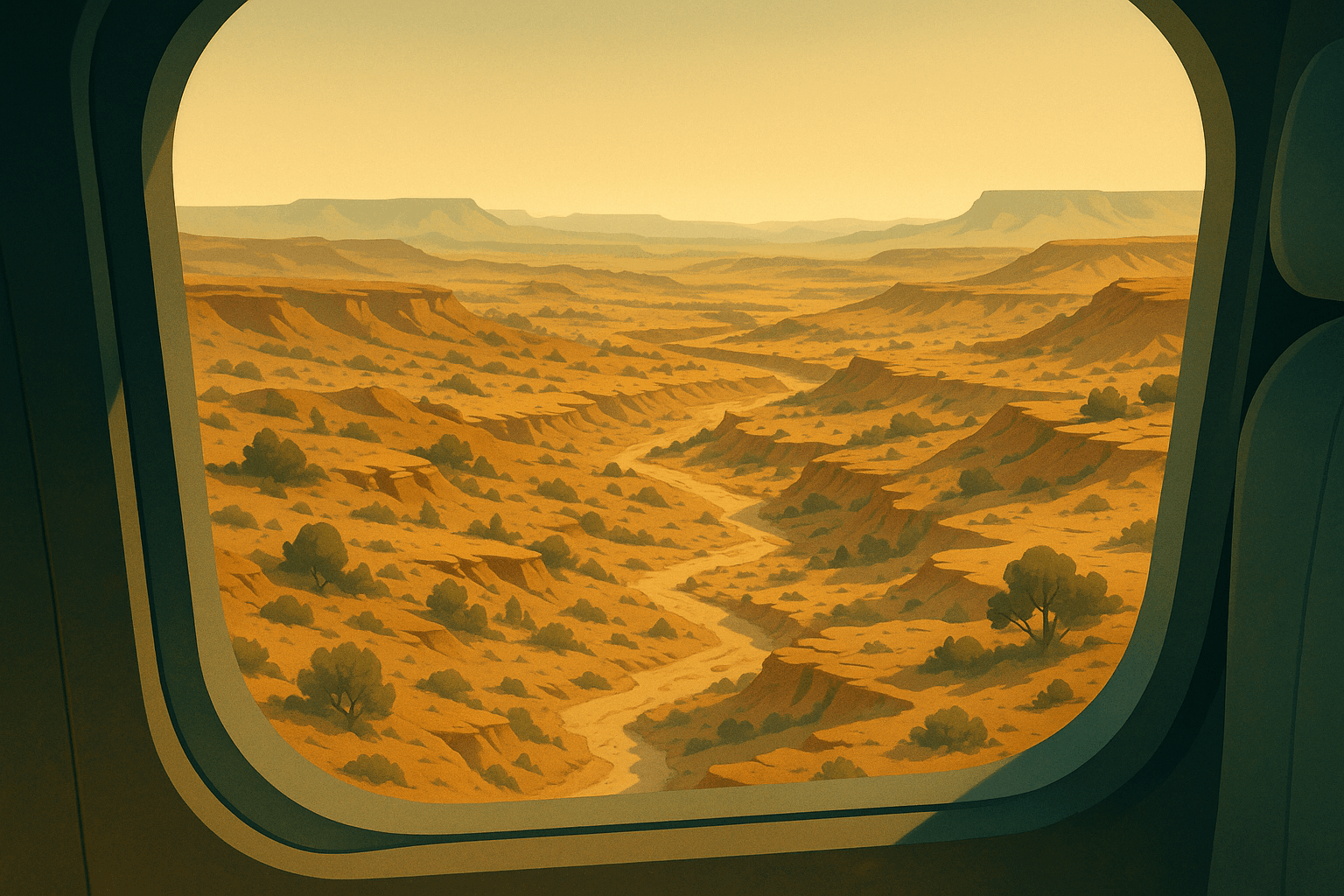
I adapted Huxley’s stereotypically old-world Native American Reservation to be more relevant to the 21st century, drawing inspiration from the global South and off-grid communities. Research about geography and makeshift technology helped me create text and visuals for a more cohesive, believable, and relevant narrative.
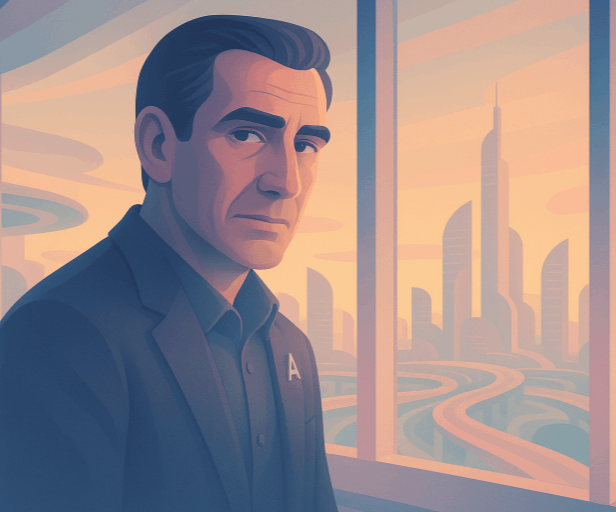
The initial draft of the debate with the World Controller felt too passive, like a lecture or Q&A. Letting the learner counter the Controller by using evidence from their own journey through the module made the final section more dynamic, with the ending choice becoming a more authentic and personal conclusion.
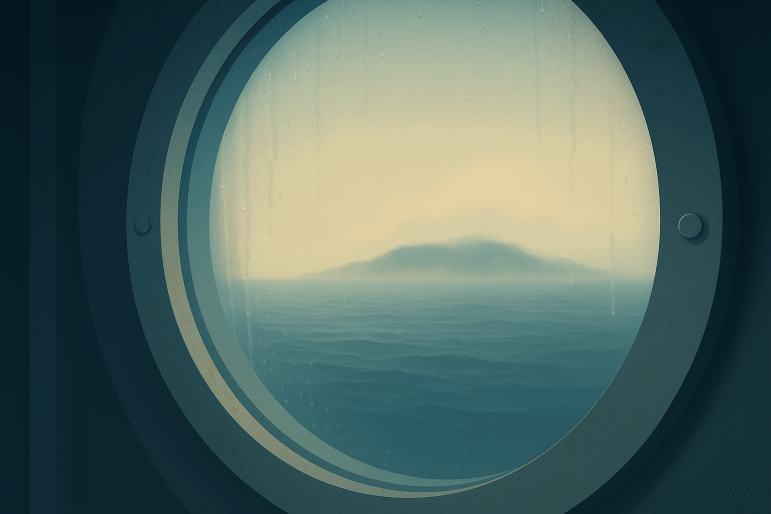
The module's weakest ending became its most meaningful. This case study details how I transformed the vague "island" choice into a metaphor for the learner's own future. Through a few strategic text edits, the final choice became a reflection on agency, uncertainty, and the courage to build a new world.
What I learned
This project was a chance to develop my skills in using new technology. Using AI to generate a cohesive set of illustrations, creating an interactive module, and setting up a website were all things that I did for the first time. The experience gave me more confidence that what I don’t know, I can learn.
The process of refining the module’s text also made me a better writer and designer. The editing process made me think about narrative elements that make a learning journey impactful, like letting the learner feel the consequences of choices and encouraging critical thinking through evidence-based debate. These are design strategies that I will carry with me into the future.
Just as importantly, I learned about managing my own time and expectations. The “production” aspects of the project — generating the images, making the slides, writing up this reflection — all took more time than planned, and challenged me to manage my perfectionism. I had to reflect on what was most important — creating a story with philosophical depth that gave the learner autonomy — and find a stopping point instead of forever making improvements. Although I know that the project can still — and always — be better, ultimately, I had to trust that my work was good enough to let it out into the world.
Looking forward
My hope is that this project fulfills the goal I had in making it: to encourage young people to reflect critically about society, and to help them more thoughtfully enter the future they will ultimately be responsible for. I also hope that the module succeeds as an adaptation — one that does justice to the complex, timeless questions of Huxley’s original book and that revitalizes them for the 21st century.
I would love to hear about how the module has been used and how learners have responded to it. Please let me know through the feedback form or by sending me a message.
As for future projects, my dream would be to continue to design thought-provoking narratives and experiences in the areas that mean the most to me: language, art, and literature; science, technology, and the environment; and philosophy and ethics.

Drag & Drop Website Builder